
As one of the first in the printing industry, we work with an official CO₂ print score on our quotations, based on the internationally recognized ClimateCalc™ method. This makes the environmental impact of printing transparent, comparable and verifiable.
What is a CO₂ print score?
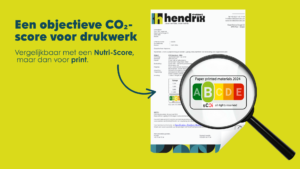
The CO₂ print score is similar to a Nutri-Score, but for print.
Each product is recalculated into CO₂ emissions per kilogram of printed matter and is given an A-E score based on that, developed by a neutral and internationally recognized body.
By calculating per kilogram, different products can be objectively compared. A bound book and a flyer differ greatly in size and weight, but their CO₂ impact can be fairly juxtaposed thanks to this method.
Certified and audited figures
The CO₂ figures we communicate are not estimates, but standardized and verified values. They are calculated according to the ClimateCalc™ method and verified by independent bodies, in line with international standards.
This approach is also in line with stricter European regulations on sustainability and communication. Terms such as “CO₂-neutral” may only be used when a product is effectively produced without emissions. Transparency and correct information are key, and this is exactly where the CO₂ print score comes in.
Understanding our direct carbon emissions
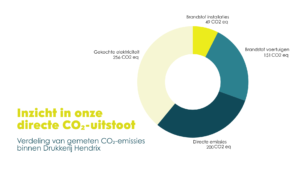
This chart shows a selection of our direct emissions (Scope 1 and 2), such as energy consumption and fuel use. These figures are part of our official ClimateCalc™ reporting and form the basis for the CO₂ print score on our quotations.
Specifically, what does this mean for customers?
Thanks to the CO₂ print score, customers and buyers:
- Understanding the carbon footprint of their printed materials
- Recognized and comparable figures within the printing industry
- The ability to provide targeted and responsible compensation, with clear justification
This makes sustainable choices not only more transparent, but also more concrete and better substantiated.
CO₂ as part of a broader sustainability policy
CO₂ emissions are a major concern, but only one component of sustainable printing. Paper today is recycled multiple times, raw materials are managed in a controlled manner, inks are biodegradable, and water and transport flows are organized more and more efficiently.
By making CO₂ emissions measurable, we add additional insight to a product that is already sustainable in many ways.
With this move, we at Drukkerij Hendrix are consciously choosing a sustainable approach that goes beyond a marketing story, and is based on transparency, quality, responsibility and a long-term vision for the printing industry.

